December 04

Add to Calendar 2025-12-04 18:30:00 2025-12-04 20:00:00 America/New_York Will Artificial Intelligence Be the End of Civilization, or the Beginning? Boston Chapter of the IEEE Computer Society and GBC/ACM7:00 PM, Thursday, 4 December 2025MIT Room 32-G449 (Kiva) and online via ZoomWill Artificial Intelligence Be the End of Civilization, or the Beginning?Henry Lieberman, MIT Computer Science and Artificial Intelligence Lab + Christopher Fry, MIT Media Lab, Sloan, IBM, startups (Retired)            https://www.whycantwe.orgPlease register in advance for this seminar even if you plan to attend in person athttps://acm-org.zoom.us/webinar/register/8917630641635/WN_FKvNEH5NQAO5nzIM_jWxxw After registering, you will receive a confirmation email containing information about joining the webinar.Indicate on the registration form if you plan to attend in person. This will help us determine whether the room is close to reaching capacity. We plan to serve light refreshments (probably pizza) before the talk starting at around 6:30 pm. Letting us know you will come in person will help us determine how much pizza to order.We may make some auxiliary material such as slides and access to the recording available after the seminar to people who have registered.Abstract:Popular press articles whipsaw the public between two starkly different views of Artificial Intelligence.  On one hand, AI is presented as a magic genie that can solve all of our problems with superhuman intelligence. On the other hand, it's presented as an unprecedented threat to humanity, with the danger of loss of jobs, loss of privacy, automated discrimination, even some kind of "robot rebellion". No wonder the public is confused. Which is it?We present a view that is different from both the self-interested promotion of the tech companies, and from the pessimism of the social critics. Believe it or not, the biggest value of AI will lie, not insimply improving the operations of today's industry and government, but in making it possible to have a more cooperative, less competitive world.Our view is:- Optimistic. Mitigating possible dangers of AI in today's society is important. But we don't want to let fear cause us to miss the potential for AI to tackle big problems people now think are intractable: war, poverty, climate, etc.- Radical. Many tech boosters imagine simply pouring AI into today's economy and electoral politics. We think these systems need to be redesigned from scratch for the AI era. We have two concrete proposals: Makerism (economics) and  Reasonocracy (governance).    - Original. Not conventionally Left or Right, though our ideas share some design goals with both sides. Not (yet) heard on mainstream or activist media. TBD

November 13

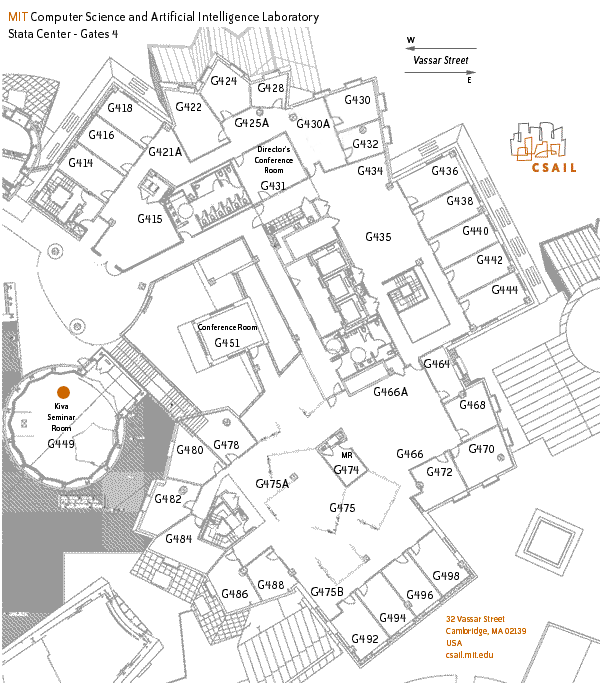
Add to Calendar 2025-11-13 18:30:00 2025-11-13 20:00:00 America/New_York Easy Acceleration with Distributed Arrays on the World's Largest Interactive AI Supercomputer Boston Chapter of the IEEE Computer Society, GBC/ACM and MIT Student Chapter of SIAM (Society for Industrial and Applied Mathematics)7:00 PM, Thursday, 13 November 2025MIT Room 32-G449 (Kiva) and online via Zoom Easy Acceleration with Distributed Arrays on the World’s Largest Interactive AI Supercomputer --- Jeremy Kepner Please register in advance for this seminar even if you plan to attend in person athttps://acm-org.zoom.us/webinar/register/1017607373508/WN_lYs4lxKfSlGkMVq71ibN-g After registering, you will receive a confirmation email containing information about joining the webinar.Indicate on the registration form if you plan to attend in person. This will help us determine whether the room is close to reaching capacity. We plan to serve light refreshments (probably pizza) before the talk starting at around 6:30 pm. Letting us know you will come in person will help us determine how much pizza to order.We may make some auxiliary material such as slides and access to the recording available after the seminar to people who have registered.Abstract:High level programming languages and GPU accelerators are powerful enablers for a wide range of applications. Achieving scalable vertical (within a compute node), horizontal (across compute nodes), and temporal (over different generations of hardware) performance while retaining productivity requires effective abstractions. Distributed arrays are one such abstraction that enables high level programming to achieve highly scalable performance. Distributed arrays achieve this performance by deriving parallelism from data locality, which naturally leads to high memory bandwidth efficiency. This talk explores distributed array performance on a variety of hardware. Scalable performance is demonstrated within and across CPU cores, CPU nodes, and GPU nodes. The interactive AI supercomputing hardware used spans decades and allows a direct comparison of hardware improvements over this time range. Bio:Dr. Jeremy Kepner is an MIT Lincoln Laboratory Fellow. He founded the Lincoln Laboratory Supercomputing Center and pioneered the establishment of the Massachusetts Green High Performance Computing Center. He has developed novel big data and parallel computing software used by thousands of scientists and engineers worldwide. He has led several embedded computing efforts, which earned him a 2011 R&D 100 Award. Kepner has chaired the SIAM Data Mining conference, the IEEE Big Data conference, and the IEEE High Performance Extreme Computing conference. Kepner is the author of two bestselling books, Parallel MATLAB for Multicore and Multinode Computers, and Graph Algorithms in the Language of Linear Algebra. His peer-reviewed publications include works on abstract algebra, astronomy, astrophysics, cloud computing, cybersecurity, data mining, databases, graph algorithms, health sciences, plasma physics, signal processing, and 3D visualization. In 2014, he received Lincoln Laboratory's Technical Excellence Award.Kepner holds a BA degree in astrophysics from Pomona College and a PhD degree in astrophysics from Princeton University. He is a fellow of the Society of Industrial Applied Mathematics (SIAM) and is a faculty advisor to the MIT SIAM student group. Directions to 32-G449 - MIT Stata Center, 32 Vassar Street, Cambridge, MA: Please use the main entrance to the Stata Center at 32 Vassar Street (the entrance closest to Main street) as those doors will be unlocked. Upon entering, proceed to the elevators which will be on the right after passing a large set of stairs and a MITAC kiosk. Take the elevator to the 4th floor and turn right, following the hall to an open area; 32-G449 will be on the left. Location of Stata on campus map  This joint meeting of the Boston Chapter of the IEEE Computer Society and GBC/ACM will be hybrid (in person and online).Up-to-date information about this and other talks is available online at https://ewh.ieee.org/r1/boston/computer/. You can sign up to receive updated status information about this talk and informational emails about future talks at https://mailman.mit.edu/mailman/listinfo/ieee-cs, our self-administered mailing list. TBD

September 25

Add to Calendar 2025-09-25 19:00:00 2025-09-25 20:00:00 America/New_York Learning, engineering, and targeting cell states in cancer Boston, Guatemala, Panama, and Peru Chapters of the IEEE Computer Society, Boston IEEE Engineering in Medicine and Biology Society (EMBS), New Jersey Coast and North Florida Sections of IEEE and GBC/ACM7:00 PM, Thursday, 25 September 2025Note Date Change from previous announcement!MIT Room 32-G449 (Kiva) and online via ZoomLearning, engineering, and targeting cell states in cancer            Ava AminiPlease register in advance for this seminar even if you plan to attend in person athttps://acm-org.zoom.us/webinar/register/WN_Msf8F_LXTcSD2mWpDeVx5AAfter registering, you will receive a confirmation email containing information about joining the webinar.Indicate on the registration form if you plan to attend in person.  This will help us determine whether the room is close to reaching capacity. We plan to serve light refreshments (probably pizza) before the talk starting at around 6:30 pm. Letting us know you will come inperson will help us determine how much pizza to order.We may make some auxiliary material such as slides and access to the recording available after the seminar to people who have registered.              Abstract:Cancer is often treated using a reductionist approach: distilled to an individual subtype, mutation, or phenotype. But fundamentally, cancers are complex ecosystems that necessitate systems-level understanding and intervention. Addressing this problem is equal parts biology and computer science. In Project Ex Vivo, a joint cancer research collaboration between Microsoft Research and the Broad Institute, we are envisioning a new, constructionist paradigm for precision oncology, one powered by the bottom-up integration of computation and experimentation to understand the complexity of cell state ecosystems in cancer. In this talk I will share our recent efforts to build AI models to better define, model, and therapeutically target cell states in cancer.Bio:Ava Amini is a Principal Researcher at Microsoft Research in Cambridge, MA. Her research focuses on developing new AI methods to understand and design biology, with the ultimate aim of realizing precision biomedicines that improve human health. She is a co-lead ofEx Vivo , a collaborative effort between Microsoft and the Broad Institute, that is focused on defining, engineering, and targeting cell states in cancer.In addition to research, Ava is passionate about AI education and outreach ??? she is a lead organizer and instructor for MIT Introduction to Deep Learning , an in-person and global course on the fundamentals of deep learning.Ava completed her PhD in Biophysics at Harvard University and the Massachusetts Institute of Technology (MIT), where she was advised by Sangeeta Bhatia at the Koch Institute for Integrative Cancer Research and supported by the NSF Graduate Research Fellowship. Ava received her Bachelor of Science in Computer Science and Molecular Biology from MIT.Directions to 32-G449 - MIT Stata Center, 32 Vassar Street, Cambridge, MA: Please use the main entrance to the Stata Center at 32 Vassar Street (the entrance closest to Main street) as those doors will be unlocked. Upon entering, proceed to the elevators which will be on theright after passing a large set of stairs and a MITAC kiosk. Take the elevator to the 4th floor and turn right, following the hall to an open area; 32-G449 will be on the left. Location of Stata on campus mapThis joint meeting of the Boston Chapter of the IEEE Computer Society and GBC/ACM will be hybrid (in person and online).Up-to-date information about this and other talks is available online at https://ewh.ieee.org/r1/boston/computer/. You can sign up to receive updated status information about this talk and informational emails about future talks at https://mailman.mit.edu/mailman/listinfo/ieee-cs, our self-administered mailing list. TBD

September 15

Add to Calendar 2025-09-15 10:30:00 2025-09-15 19:30:00 America/New_York High Performance Extreme Computing Virtual Conference, Sept 15-19  The Boston Chapter of the IEEE Computer Society is joining with SIAM (the Society for Industrial and Applied Mathematics) as cooperating society co-sponsors of this year's High Performance Extreme Computing Virtual Conference September 15-19.  The primary organizer is MIT Lincoln Lab and its Supercomputing Center.The conference has over 150 speaker presentations (many involving CSAIL presenters or co-authors) and complementary (FREE) registration is available.  (There is also a regular registration available that includes conference proceedings for about $200, but for most people FREE is almost always a good deal.  See the registration page linked to below for details about differences in registration type.  Signing up for free registration is particularly worthwhile if you only expect to attend one or  a few presentations.) The conference will be held virtually on the Engagez platform, allowing for networking with other attendees across the globe.You can see an overview of the conference at <https://ieee-hpec.org/>.The registration page is at<https://ieee-hpec.org/index.php/conference-registration/>.The keynotes speakers includeDay 1 Keynote:  Dr. Nick Rotker (MITRE Chief BlueTech Strategist) --- Enabling Advances in OceanAIDay 2 Keynote:  Prof. Julie Shah (MIT AeroAstro Dept Head)Day 3 Keynote:  Dr. Ashley Conard (Microsoft) --- Building AI That Users TrustDay 4 Keynote:  Joshua Patterson (NVIDIA VP of Solutions Engineering) --- SPACE MICE: The Next  Generation Data SystemsDay 5 Keynote:  Prof. Bill Gropp (NCSA Director; AAAS, ACM, IEEE, NAE & SIAM Fellow) --- Performance Engineering with MPIOther CSAIL/MIT presenters include Chuchu Fan, Cathy Wu, Srini Devadas and Sara Beery.  Mike Stonebraker is a paper co-author and is on the conference advisory committee.Special sessions includeAge of Mixed-Precision: Algorithms, Libraries, and Applications; organizer: Dr. Piotr Luszczek (MIT LLSC & UTK ICL)Bridging Quantum and High Performance Computing; organizer: Prof. Devesh Tiwari (Northeastern Univ.)GenAI Opportunities and AI Challenges; organizer: Dr. Vijay Gadepally (MIT LLSC), Dr. Daniel Burrill (MIT LLSC), Dr. Christian Prothmann (MIT CSAIL)Fastcode @ HPEC; organizer: Dr. Bruce Hoppe (MIT)MIT/Amazon/IEEE Graph ChallengeGraphBLAS Forum to define standard building blocks for graph algorithms; organizers: Dr. Timothy Mattson (HLG), Dr. Ben Brock (Intel), and Dr. Scott McMillan (CMU SEI)BRAINS: Building Resilience through Artificial Intelligence for Networked Systems; organizers: Dr. Sandeep Pisharody (MIT LL) and Dr. Thomas Hardjono (MIT)Scaling Research Computing Education; organizers: Dr. Julie Mullen (MIT LLSC),  Lauren Milechin (MIT ORCD), and Dr. Hayden Jananthan (MIT LLSC)The full program is online at <https://ieee-hpec.org/index.php/ieee-hpec-2025-prelim-agenda>.  TBD